
Cost Reduction
Reduce Operating Costs By
30-75%

Reduce Operating Costs By
30-75%

Generate Additional
Revenue Through Power
Market Participation

System Availability >=99.8%
With 24/7 Monitoring

Scalable From 100 kWh To
5 MWh+

Compliant With VDE/DIN/
IEC Standards
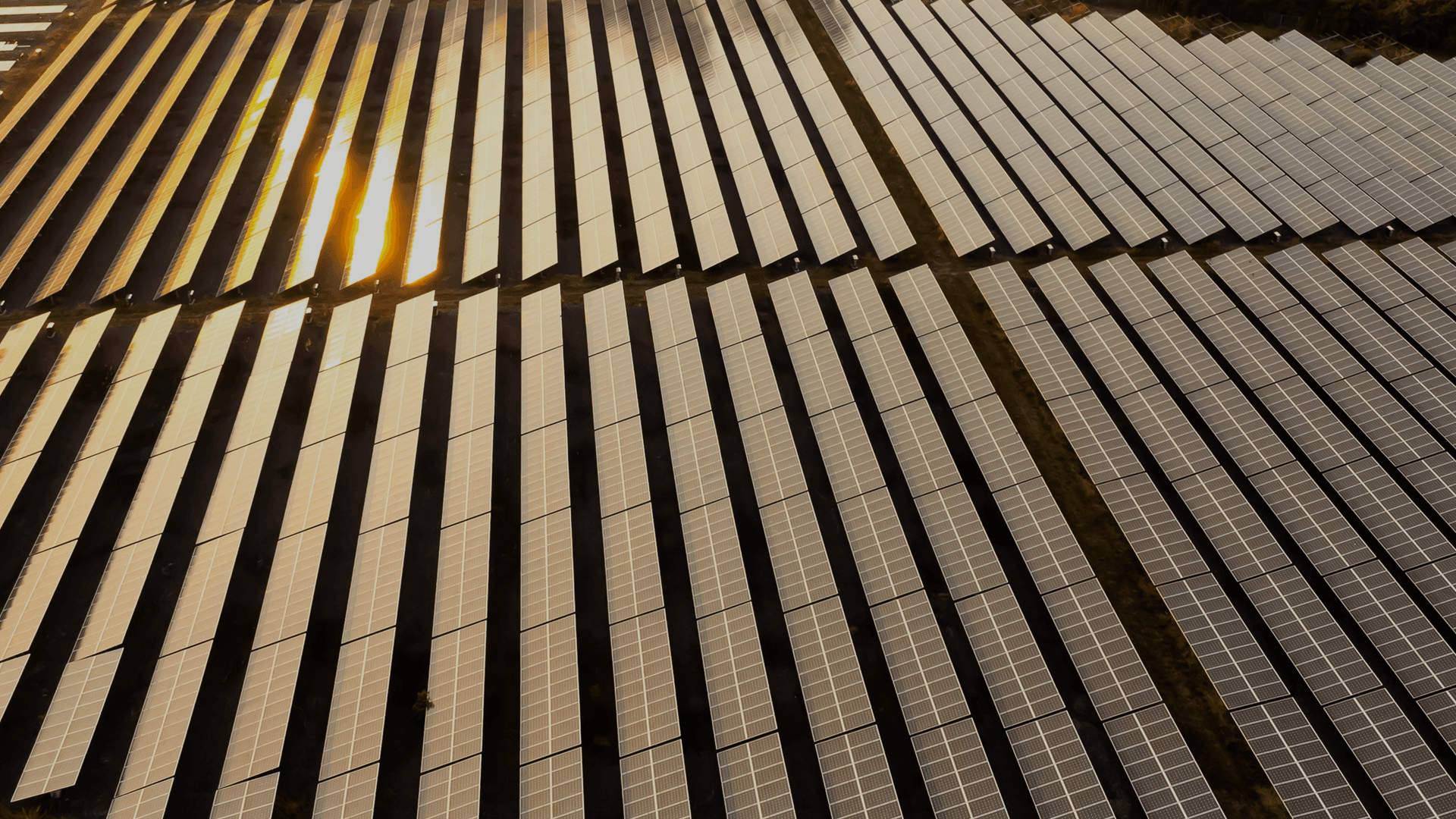
The installed Borochi C&I energy system combines PV generation, battery energy storage and EV charging in one integrated solution. Through coordinated energy management, the system makes efficient use of locally generated solar energy. Depending on the site’s energy demand, PV generation can be used directly, stored in the battery, or utilized for EV charging, helping to increase the use of renewable energy and reduce dependence on grid electricity. A further highlight of the project is the integration of dynamic electricity pricing. The system can automatically plan battery charging and discharging according to changing electricity prices and site conditions, allowing energy to be used more flexibly and economically.
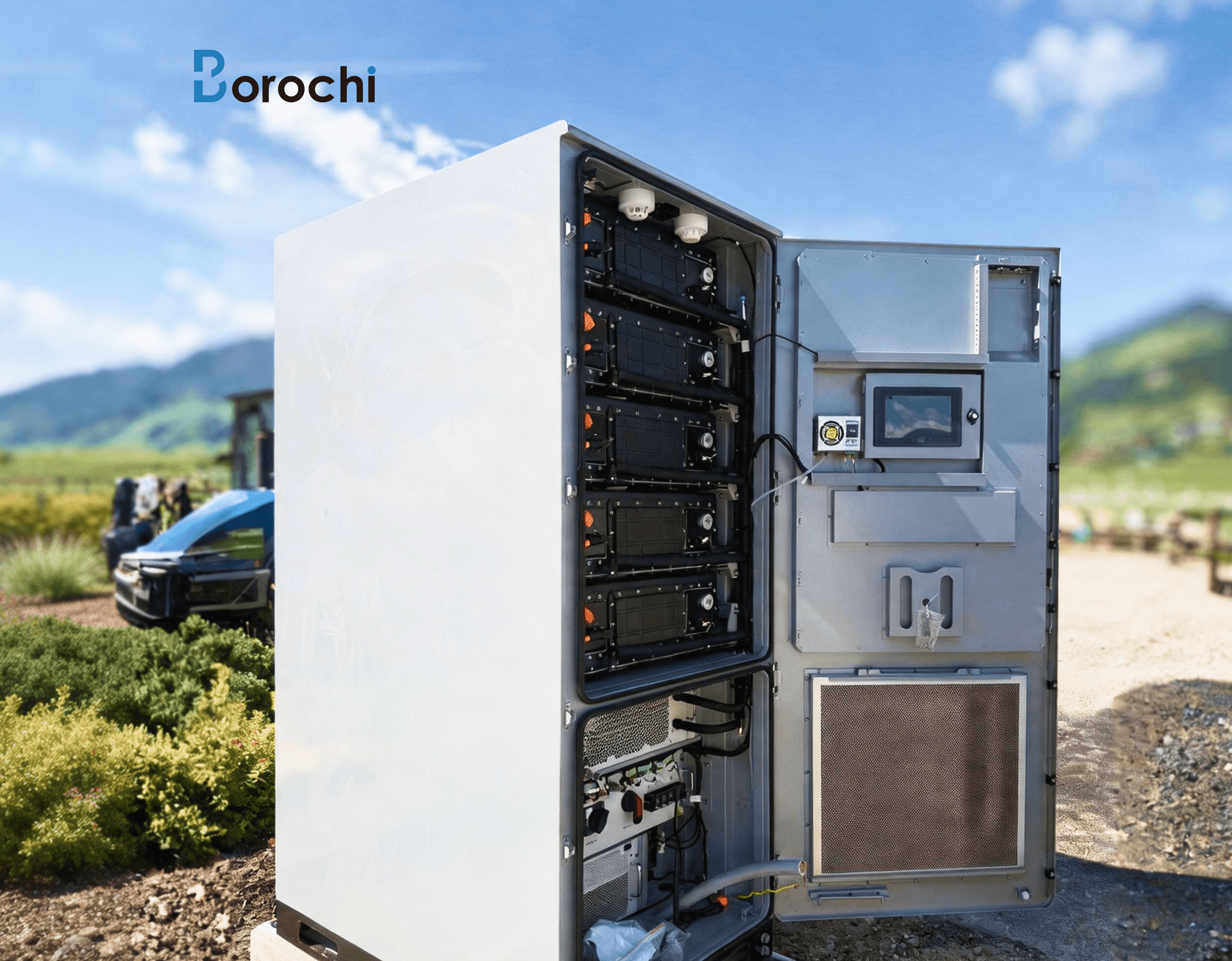
Positioning: Tailored for light commercial use, office buildings, retail shops, and small factories, or clients seeking a “Self-Consumption + Backup Power” solution.
A fully integrated system combining inverter, battery, BMS, and EMS into a single unit.
Pre-assembled for delivery, enabling rapid installation and easy capacity expansion.
Facilitates remote O&M, data management, and automated system optimization.

Industrial and commercial scenarios are diverse. We support multi-solution customization. Ultimately, we provide design, consultation, EMS management, and application support.
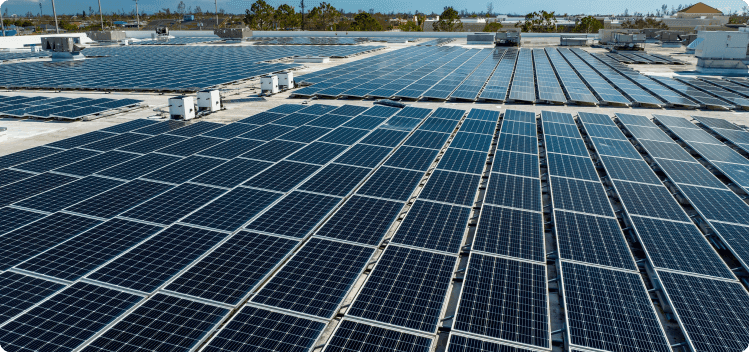
Borochi commercial and industrial energy storage is suitable for hotels, factories, office buildings, warehouses, business parks and charging stations. It can also be deployed alongside solar farms or as a standalone storage project. Depending on the project, it can increase solar self-consumption, reduce peak grid demand, optimise charging around dynamic electricity prices and, where market access requirements are met, support electricity trading and ancillary services.
On-site use to reduce energy costs: For hotels, factories, offices and warehouses, storage can retain surplus solar energy for later use, supply additional power during demand peaks or charge and discharge in response to dynamic prices. The appropriate strategy depends on the site's load profile, electricity contract and installed equipment.
Storage alongside solar farms: Borochi storage can be installed as part of a solar farm project. A renewable-only storage arrangement, known in Germany as a Grünstromspeicher, stores the site's solar generation and shifts its export to suitable times. A grid-charged arrangement, or Graustromspeicher, can charge from the grid and operate in electricity markets where the relevant conditions are met. The design must reflect grid connection, metering and trading requirements.
Standalone storage for electricity markets: A Borochi storage project does not need an associated PV installation or substantial on-site demand. It can be used for electricity price arbitrage and, once the technical and market entry requirements are met, for ancillary services.
Suitability depends on the project conditions, not simply the industry. Borochi can help determine the storage power, energy capacity and operating approach based on the load profile, PV installation, grid connection limits and commercial objectives.
Borochi commercial and industrial storage can help factories and industrial parks increase solar self-consumption, reduce peak demand and take advantage of dynamic electricity tariffs. This can reduce grid purchases and demand-related charges while shifting some electricity purchases to lower-priced periods.
Use daytime solar energy during evening and night shifts: Sites with PV can store solar electricity that is not immediately needed and use it during late shifts, at night or when solar output is low. This increases the share of solar generation used on site and reduces reliance on purchased electricity.
Reduce peak grid demand: When production equipment, air conditioning and charging facilities run at the same time, the battery can supply part of the load and reduce demand at the grid connection point. For businesses billed a demand charge, known in Germany as the Leistungspreis, this can reduce the cost associated with maximum grid demand. Savings depend on the tariff, the duration of the peaks, storage discharge power and available energy.
Avoid expensive periods with dynamic tariffs: Businesses on a dynamic electricity tariff can charge the battery when prices are lower and use the stored energy when prices are higher. Charging must also take the site's load into account to avoid creating a new demand peak.
These strategies need to be coordinated. Savings should be assessed using the load profile, electricity contract, PV generation, storage power and capacity, and charging and discharging losses. Even without PV, a business may benefit from peak shaving and dynamic tariff optimisation.
A well-designed combination of PV, battery storage, EV charging and heat pumps for space heating and domestic hot water can increase solar self-consumption and reduce grid purchases. Borochi can provide the relevant equipment solutions. The operating strategy depends on each building's energy needs and project configuration.
Offices: Office electricity demand often coincides with daytime solar generation. PV can supply office equipment, lighting, ventilation and heat pumps, as well as employees' vehicles parked during the day. Surplus energy can be stored for the evening or other periods of low solar output.
Shopping centres: Lighting, air conditioning, lifts and customer charging all contribute to the site's demand. PV can meet part of the daytime load, while storage can supplement power during peaks when suitable controls are in place. The number and power rating of chargers should be planned around the building's demand and available grid connection capacity.
Hotels: Hotels need to maintain guest comfort and a dependable hot water supply alongside their other electrical loads. Storage can shift surplus daytime solar energy to the evening or night. With a suitable hot water cylinder, a heat pump can also use daytime solar electricity to heat water in advance, where operating conditions allow.
Automatically coordinating all equipment, dynamically allocating charging power or optimising across devices requires a separately specified, compatible energy management system (EMS). Device interfaces and control compatibility must be checked. The designer and installer should base the solution on load profiles, opening hours, hot water demand and grid connection limits.
Yes. Battery storage can act as a power buffer, supplementing the grid supply during DC fast charging or simultaneous fleet charging. A suitably designed system can support more charging points and reduce or defer the need to upgrade the grid connection.
How the buffer works: When other site loads or charging demand are low, the battery charges using spare grid connection capacity. If PV is installed, it can also store surplus solar energy. When charging demand exceeds the remaining grid capacity, the battery supplies part of the shortfall.
Power coordination requires an EMS: A compatible energy management system must coordinate the grid limit, other site loads, battery state of charge and charging and discharging capability. It adjusts storage and charger power to keep the site within its connection limit. For a Borochi storage project, this EMS must be specified separately during design, with control interfaces and compatibility confirmed in advance.
What limits the solution: Discharge power determines how much additional charging power is available; usable battery energy determines for how long. The design must account for vehicle numbers, arrival and departure times, and charging requirements. A site operating continuously at high demand may still need a grid upgrade.
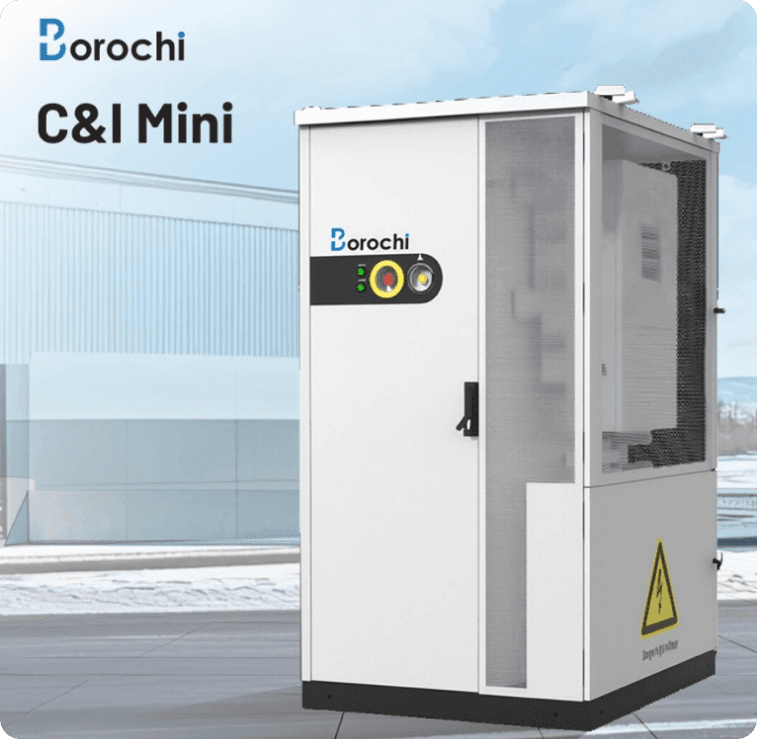
Yes. The Borochi C&I Mini (50 kW / 120 kWh) can be combined with PV and a diesel generator to create a hybrid power supply for sites with limited grid access or an unreliable supply. Customers are already using this configuration.
With a suitable control system, solar generation supplies the site first and surplus energy charges the battery. Storage supplements the supply when solar output is insufficient; the diesel generator provides power when PV and the battery cannot meet demand. This can increase solar self-consumption and reduce generator running hours and fuel consumption.
The system must be designed around site loads, equipment starting power and continuity-of-supply requirements. Generator and storage interfaces must be compatible, with suitable controls for charging, discharging and generator start/stop operation.
Yes. Borochi commercial and industrial storage cabinets can be used for standalone projects without PV or significant on-site demand. These systems charge from and discharge to the grid, primarily for electricity trading and, where the relevant requirements are met, ancillary services such as frequency regulation.
Parallel connection at a single site: Multiple Borochi cabinets can be connected in parallel to increase power and energy capacity. The system is sized around the grid connection and target market. It can charge during low-price periods, discharge when prices are higher or provide controllable power in response to dispatch instructions.
Aggregation across multiple sites: Storage cabinets can also be installed at different locations and managed by an aggregator through a virtual power plant (VPP). The systems form a pool that meets the relevant market requirements, so each site does not have to meet the full minimum bid size on its own.
Germany's FCR, aFRR and mFRR markets commonly use a minimum bid size of 1 MW. However, marketable power depends on available power, the ability to sustain delivery and prequalification results; it is not simply the sum of nameplate ratings. Information reference date: September 2026. Source: regelleistung.net.
The project requires a compatible EMS, metering and remote dispatch system. The trader or aggregator must confirm market access, including settlement arrangements with the balance responsible party (BRP), control-area and aggregation rules, grid connection requirements and the necessary qualifications. Borochi storage should be sized against these conditions and the project's operating objectives.
The Borochi C&I Mini is rated at 50 kW / 120 kWh per cabinet, while the C&I Max provides 125 kW / 262 kWh. They differ in power conversion technology, cooling method and the scale of projects they serve.
C&I Mini for smaller PV and storage projects with backup power: The Mini uses a hybrid power conversion system (Hybrid PCS) and air cooling. It is particularly suited to new, smaller commercial PV and storage installations, helping increase solar self-consumption and provide backup power to essential loads. With the appropriate backup wiring and system configuration, transfer between grid-connected and off-grid operation can take as little as 10 ms.
C&I Max for larger projects and expansion: The liquid-cooled Max is designed for factories, business parks, charging stations and other sites with higher power and capacity requirements. Parallel operation enables expansion to megawatt-scale power. With a compatible EMS or dispatch platform, applications include peak shaving, solar self-consumption, dynamic tariff optimisation and coordinated PV, storage and charging. Electricity trading is also possible once market access requirements are met.
Choose the system based on power demand, energy capacity, PV connection design, backup requirements and future expansion plans.
Borochi offers integrated storage cabinets and containerised systems for different project sizes and applications:
• C&I Mini: 50 kW / 120 kWh, for smaller commercial and industrial projects.
• C&I Max: 125 kW / 262 kWh, for medium-sized and larger projects, with expansion through parallel connection.
• Containerised storage: 2–5 MWh, for projects requiring more energy capacity. Power is specified for the individual project.
Power and energy capacity: Power, measured in kW, determines how much load the battery can support while charging or discharging. Energy capacity, measured in kWh or MWh, determines how much electricity it can store. Both need to be considered when sizing a system.
Selecting the configuration: Sizing should take account of the load profile, peak demand and its duration, PV capacity and surplus generation, permitted grid import and export power, and the intended application: peak shaving, self-consumption, backup power or electricity trading.
Data for the assessment: Ideally, provide a complete recent year of 15-minute load data, the electricity contract and PV data, if available. Fifteen-minute intervals are commonly used for registered load measurement in Germany. These inputs allow configurations to be compared for performance and economics, avoiding a system that is either too small or unnecessarily large.
Runtime depends primarily on usable battery energy and actual discharge power. Whether the system can cover a demand peak also depends on the gap between peak load and the target grid import limit, how long the peak lasts and the battery's charge level beforehand.
Estimating runtime: Runtime in hours $\approx$ usable energy in kWh $\div$ discharge power in kW. Using nominal capacity and rated power, the C&I Mini (50 kW / 120 kWh) has a theoretical discharge duration of about 2.4 hours, and the C&I Max (125 kW / 262 kWh) about 2.1 hours. These figures do not account for the permitted state-of-charge (SOC) range, reserved energy or system losses, so actual runtime will be shorter.
Peak shaving only covers the excess demand: The battery only needs to supply the portion above the target grid import limit, rather than the entire site's load. For example, if site demand reaches 200 kW and grid import is to stay at 150 kW, the battery needs to supply around 50 kW. Covering that peak for one hour requires at least about 50 kWh of usable energy, plus an allowance for losses.
Assess the power shortfall, its duration and the battery's available energy before the peak. A compatible control system must plan charging and reserve sufficient energy. Where power or capacity is insufficient, parallel expansion may be an option, subject to project conditions.
Yes, parallel operation and later expansion are possible. However, power and energy capacity cannot be increased independently. Expansion uses complete cabinets, so both increase together in the fixed ratio provided by each cabinet.
Maximum parallel configuration:
• C&I Mini (50 kW / 120 kWh): up to 6 cabinets in either grid-connected or off-grid operation, providing a total rated power of 300 kW and nominal capacity of 720 kWh.
• C&I Max (125 kW / 262 kWh): up to 10 cabinets per subsystem in grid-connected operation, providing 1,250 kW / 2,620 kWh; up to 6 in off-grid operation, providing 750 kW / 1,572 kWh.
Planning for later expansion: Future expansion requires checks on equipment compatibility, grid connection capacity, distribution and protection equipment, the control system and available space. Allowing for expansion during the initial design makes later upgrades easier to accommodate.
The C&I Mini can be configured for backup power. The C&I Max requires additional equipment; the storage cabinet alone cannot perform the transfer needed to maintain supply during a grid outage.
C&I Mini 50 kW / 120 kWh: With the appropriate backup wiring and protection, the Mini can continue to supply loads connected to the backup circuits during an outage. Transfer between grid-connected and off-grid operation can take as little as 10 ms.
The total continuous load must not exceed 50 kW per cabinet. For motors, pumps, compressors and other loads with high starting currents, the starting peak and its duration must also be checked against the capability of the power conversion system (PCS).
C&I Max 125 kW / 262 kWh: The Max requires an additional uninterruptible power supply (UPS) for its auxiliary equipment and communications. This keeps essential control and communication functions running during an outage and, together with a complete transfer arrangement, enables the transition between grid-connected and off-grid operation. The UPS supports the auxiliary systems; it should not be understood as supplying all production loads.
The Max's supported backup loads and transfer time must be confirmed for the final system configuration. For both products, backup duration depends on the battery energy available at the start of the outage and the actual load.
The Borochi C&I Max is designed for outdoor installation. The C&I Mini can be installed outdoors or in a suitable indoor location. Site selection must consider foundation load capacity, service clearances, ambient temperature, noise and project-specific fire protection requirements.
C&I Max 125 kW / 262 kWh:
• Foundation and clearances: the foundation must support a cabinet weighing approximately 2.6 tonnes. A foundation height of 300 mm above ground level is recommended. Allow the ventilation, wiring, door-opening and service clearances specified in the installation manual.
• Operating ambient temperature: −30 °C to +55 °C.
• Operating noise: no more than 60 dB(A) at a distance of 3 m.
• Fire protection: aerosol fire suppression and a fire-water system.
C&I Mini 50 kW / 120 kWh:
• Foundation and clearances: the supporting structure must accommodate a cabinet weighing approximately 1.3 tonnes. Indoors, allow at least 1.1 m at both the front and rear and 0.3 m above the cabinet, with adequate room ventilation.
• Operating ambient temperature: −20 °C to +55 °C.
• Operating noise: no more than 75 dB(A) at a distance of 3 m.
• Fire protection: perfluorohexanone fire suppression system.
The operating temperature range does not imply full-power operation throughout that range. Built-in fire protection does not replace the site's fire safety design. Confirm the installation against the product manual and local requirements, and assess noise at nearby offices, hotel rooms or homes.
The economics of a Borochi commercial storage project must be assessed using the business's actual energy data. The key is to compare operation with and without storage, quantify the benefits of solar self-consumption, peak shaving and dynamic tariff optimisation, and include all investment and operating costs.
Data required: Ideally, provide a complete recent year of 15-minute load data, the electricity contract and bills, plus PV generation and export data where available.
Calculating the business case: Comparing operation before and after installation helps quantify savings and identify suitable power and capacity. Include equipment, installation, grid connection and control system costs, as well as operating losses, maintenance and service fees. Benefits must not be counted twice.
Indicative payback: With suitable system sizing and operating conditions, some commercial storage projects participating in electricity trading are projected to pay back in around 5–6 years. This is a reference range; the actual payback for a Borochi project must be calculated individually using its investment costs, energy data and trading or operating model. Information reference date: September 2026.
Borochi commercial and industrial storage can provide the equipment for electricity trading or ancillary service projects. Participation also requires suitable controls, market access arrangements and professional operating services.
Electricity trading and dynamic tariffs: Here, electricity trading means buying and selling power in the day-ahead and intraday markets through a trader or aggregator, with the battery following the corresponding charge and discharge schedules. Charging in response to a dynamic retail tariff to reduce a site's own electricity costs is not the same as participating in those markets.
Four key requirements:
• Grid connection and metering: confirm permitted import and export power, complete connection formalities and install metering suitable for market settlement.
• Control and communications: provide a compatible energy management system (EMS) or dispatch controller for remote charging and discharging, with monitoring of power, available energy and equipment status.
• Market access: agree the arrangements with a trader or aggregator, including the balance responsible party (BRP), settlement, service fees and revenue sharing. Smaller units may participate through aggregation where the rules allow.
• Ancillary service qualification: frequency regulation and similar services require the relevant response speed, delivery duration and availability, plus prequalification and the necessary contracts.
Operating responsibilities: Professional traders, aggregators or qualified balancing service providers generally handle bidding, dispatch and settlement. Maintenance is performed by the project's appointed service provider. During design, confirm compatibility with the control platform and clearly allocate equipment supply, system integration and market operation responsibilities.
Businesses can assess different storage ownership and operating models according to their budget, ownership preferences and operating needs. The options available depend on the project and the services offered by suppliers, finance providers and operators.
Purchase and operating options:
• Direct purchase: the business invests in and owns the system, benefiting from energy savings or market revenue. Maintenance and trading can be outsourced.
• Loans or leasing: bank finance, finance leases or equipment rental spread the initial funding requirement. Ownership, payment terms and maintenance responsibilities are defined in the contract.
• Third-party investment and operation: an investor funds all or part of the project. The business provides the site and agreed infrastructure, paying service fees or sharing savings and operating revenue under the contract.
• Outsourced trading: the business retains ownership and appoints a trader or aggregator to manage electricity trading or ancillary services. Fees, revenue sharing and risk allocation are agreed contractually.
KfW 270 financing in Germany: Eligible storage projects in Germany can consider promotional loans such as KfW 270, the Erneuerbare Energien – Standard programme offered by Germany's KfW development bank. This is repayable financing, not a direct grant. Applications are normally made through a financing bank, with the required process completed before the project starts. Information reference date: September 2026. Source: KfW's official programme information, Merkblatt 270.
Regional grants: Any additional investment grants must be checked for the project's federal state or municipality, company size, storage application and application date. There is no single grant percentage that can be promised for every project.
Please provide the project location, intended application, energy data, grid connection details and installation-site information. These help determine suitable storage power, energy capacity and supporting equipment.
Recommended project information:
• Project overview: address, sector or application, target installation date and objectives such as solar self-consumption, peak shaving, EV charging, backup power or electricity trading.
• Consumption and tariffs: annual electricity use, recent bills and the electricity contract; ideally, a complete recent year of 15-minute load data.
• Existing and planned equipment: PV capacity and generation data, plus power ratings and usage requirements for charging facilities, heat pumps or major production equipment.
• Grid connection: voltage level, permitted import and export power, transformer rating and, if available, a single-line diagram (SLD).
• Site details: photographs or a plan of the proposed location, available space, delivery and lifting access, and the approximate distance to the electrical connection point.
An initial assessment can begin with the information already available. For standalone trading projects, substantial on-site consumption is not a prerequisite; the focus is on grid connection conditions, available space and the intended system size. The final design and quotation depend on confirmed technical and site conditions and an agreed scope of supply and installation.
A Borochi commercial storage project typically involves assessing requirements, designing the system, applying for grid connection, delivering and installing the equipment, and completing commissioning and acceptance. The overall schedule depends on project size, grid conditions and site works.
Four project stages:
• Assessment and design: analyse energy data and project objectives, then specify storage power, capacity, connection design and controls.
• Connection approval and formalities: confirm grid operator requirements and complete the necessary approvals and metering design.
• Delivery and installation: arrange equipment supply and carry out foundation, cabling, distribution and communications work.
• Commissioning and acceptance: test protection, metering and controls, and complete the required acceptance and grid connection procedures. Trading and ancillary service projects also require market onboarding and the relevant qualification steps.
Project duration: The overall implementation period is different from the time the site may need to be without power. Projects with sufficient existing grid capacity are generally easier to progress. Grid upgrades, transformer modifications or additional approvals can extend the schedule substantially. A delivery timeline should be provided once the initial design and connection conditions are confirmed.
Impact on production: Installation does not necessarily require a full production shutdown, although connection to the existing distribution system may involve a planned power interruption. Work can be scheduled for weekends, maintenance windows or non-production periods. Agree the affected circuits and interruption duration in advance to minimise disruption.
Service responsibilities for a Borochi commercial storage project are shared between Borochi, the installer or system integrator, and the appointed operations and maintenance provider. The scope of service, responsibilities and response times should be defined in the contract and handover documents.
Equipment warranty: Borochi handles equipment warranty matters under the applicable product warranty terms. Installation work and third-party equipment remain the responsibility of the relevant parties. Warranty duration and coverage are defined in the warranty documents for the products supplied.
Routine maintenance: The business's appointed maintenance team or contracted service provider carries out inspections and servicing in line with the equipment requirements and retains maintenance records.
Remote monitoring: The agreed monitoring or operating provider is responsible. Define the monitored functions, alarm recipients and response process in advance. Connecting equipment to the internet does not automatically include round-the-clock human monitoring.
Fault resolution: The business first contacts its designated service or maintenance point, which organises initial troubleshooting. For issues involving Borochi equipment, the Borochi after-sales team provides technical support and coordinates further action according to the diagnosis and warranty terms.
At handover, establish a single contact point for reporting faults, with contact details for all parties and a clear escalation process.
Loading...